WHAT SPORTS CAR RACING TAUGHT ME ABOUT BUSINESS

What Sports Car Racing Taught Me About Business

What Sports Car Racing Taught Me About Business

What-Car-Racing

What if I told you that running a business and car racing is almost identical? Most people do not know that car racing is one of my passions. You might not know that when I was a kid, I used to drag race cars and race Motocross. A few years back, I was on the pit crew for Starworks Motorsports. Because I did not move as fast as I used to, I wouldn’t be one of those guys you see jumping over the wall. Instead, I did lollipop. Lollipop? The sign looks like a lollipop! The lollipop guy holds the sign to stop the car coming into the pits at the exact right spot, so my pit crew can fuel the car, change tires, and/or do a driver change. After I get the car to stop, I hand a tire to a member of my crew and then I pull an air hose back over the wall. All this happens in less than 40 seconds. It is a tightly choreographed process. If a mistake is made in the pits you can lose a race.

Why does all this matter? I have come to realize how car racing and running a business both require a highly coordinated team to succeed. It is not a one-man band. Like race car drivers, business owners are confident in taking risks because of the team they have behind them. Business owners wear many hats; many times, we deal with the financial gains and risks of owning a business. Like driving a race car, owning a business is for the hard worker, risk-taker, and visionary. Their lives and our livelihoods are at risk. Performances by the team have the most significant impacts on us from the eyes of our fans or clients. To succeed, our teams need to know the goals and be motivated to reach the finish line.

As proven by the Chinese virus, a successful business does not pause, it adapts. A business owner must take the time to lead, manage, motivate to ensure that employees perform at their full potential. In racing, inadequately trained pit crews can result in wasted time where every second counts. The best teams are the ones that learn from their mistakes, improve their processes, and recover quickly. Even with the best pit crew, there is still a risk associated with being the driver. Like drivers, business owners take the highest risk, putting their blood, sweat, and tears into trying to win the race.

Confidence on the racetrack and in business is essential. The crew must be ready, motivated, and focused on doing the job. The driver must have confidence in the team. We cannot win the race alone and it is crucial to be completely confident in your teams’ ability to complete their task.

I want my team to know that they have my support and that I have confidence that we can succeed, whether it be securing a new client or winning a race. The employees and the pit crew can only do so much, but without trust and a leader in place, it is not easy to find the motivation to work as a team to get the job done.

My team should feel just as accomplished as I do when things go in the right direction. We all must celebrate our accomplishments together, just like how we learn from our mistakes together. The first person the driver hugs after he wins the race is his crew. Similarly, when things go well, we as owners thank and show appreciation to our employees first. It is surprising what people can do when they are a part of something bigger than themselves.

Although our hobbies can teach us all a few things about business, there are some things you WON’T learn, like some of the common money mistakes that business owners make.

bob rubin

Are you concerned about inflation, ESG compliances, and the 2022 crypto crash?

Your investment portfolio can be affected by any or all of these factors.

Schedule an appointment with Bob Rubin, your dedicated, conservative financial advisor, for a free portfolio analysis today.

Get started by clicking the button below.

No BS… Just straight forward advice

Contact Bob, the Nation’s Predominant
Politically Conservative Financial Advisor Today!

Call Bob @ (561) 288-1111

Email Bob @ Bob@RubinWA.com

Or schedule a call below!

ESG Investing

The Harsh Reality about ESG Investing

ESG Investing


Trillions of Dollars Spent On ESG

There were more than $2.7 trillion in assets under the management of global exchange-traded “sustainable” funds in December 2021, 81% were based in European funds, and 13% were in U.S. funds. These funds target investing in environmental, social, and governance (ESG) issues. In the fourth quarter of 2021 alone, $143 billion in new capital flowed into these ESG funds.

What has been the experience of investors? Evidently, not well at all.

The financial performance of ESG funds is undoubtedly poor. Over $8 trillion of investor savings were analyzed by University of Chicago researchers in a recent Journal of Finance paper. Even though the highest sustainability funds attracted the most capital, none of them outperformed the lowest sustainability funds.

Investors might be willing to reduce financial returns to achieve better ESG performance if that result is expected. Unfortunately, ESG funds don’t seem to deliver better ESG results either.

147 ESG fund portfolios and 2,428 non-ESG fund portfolios were compared by Columbia University and London School of Economics researchers to understand how companies perform in terms of environment, society, and governance. Both labor and environmental regulations were less respected by the companies in the ESG portfolios. In addition, they found that compliance with labor and environmental laws did not improve after companies were added to ESG portfolios.

Sacrificing Financial Returns without much Gain

There are numerous instances of this. An ESG score comparison was conducted by the European Corporate Governance Institute between 684 institutional investors who signed the United Nations Principles of Responsible Investment (PRI) during 2013–2017 and 6,481 institutional investors who did not sign the PRI during that period. After signing the PRI, they did not observe any improvement in the ESG scores of companies owned by signatory funds. As a result, the financial returns for PRI signatories were lower, and the risks were more significant.


What is the reason for the poor performance of ESG funds? In competitive labor and product markets, corporate managers should pay attention to employee, customer, community, and environmental interests of their own accord to maximize long-term shareholder value. This may explain the lack of an express emphasis on ESG. As a result, setting ESG targets can distort decision-making.

Additionally, there are some signs that companies embrace ESG to hide poor business performance. Ryan Flugum and Matthew Souther of the University of South Carolina published a study recently showing that managers often mention their focus on social and environmental factors when earnings expectations (set by analysts following their company) underperformed. However, they made few public statements regarding ESG when they exceeded earnings expectations. Sustainable fund managers who invest in companies that embrace environmental, social, and governance principles may be overinvesting in companies that are underperforming in the financial sector.

Based on the evidence presented, investing in companies that adopt ESG publicly sacrifice financial returns without gaining much.
 
If you’re more interested in how to achieve financial gains instead of perpetuating underperforming woke strategies, call Rubin Wealth Management to learn more.
bob rubin

Are you concerned about inflation, ESG compliances, and the 2022 crypto crash?

Your investment portfolio can be affected by any or all of these factors.

Schedule an appointment with Bob Rubin, your dedicated, conservative financial advisor, for a free portfolio analysis today.

Get started by clicking the button below.

No BS… Just straight forward advice

Contact Bob, the Nation’s Predominant
Politically Conservative Financial Advisor Today!

Call Bob @ (561) 288-1111

Email Bob @ Bob@RubinWA.com

Or schedule a call below!

Biden

Biden Debt Cancellation Blatant and Destructive Bribery

Biden

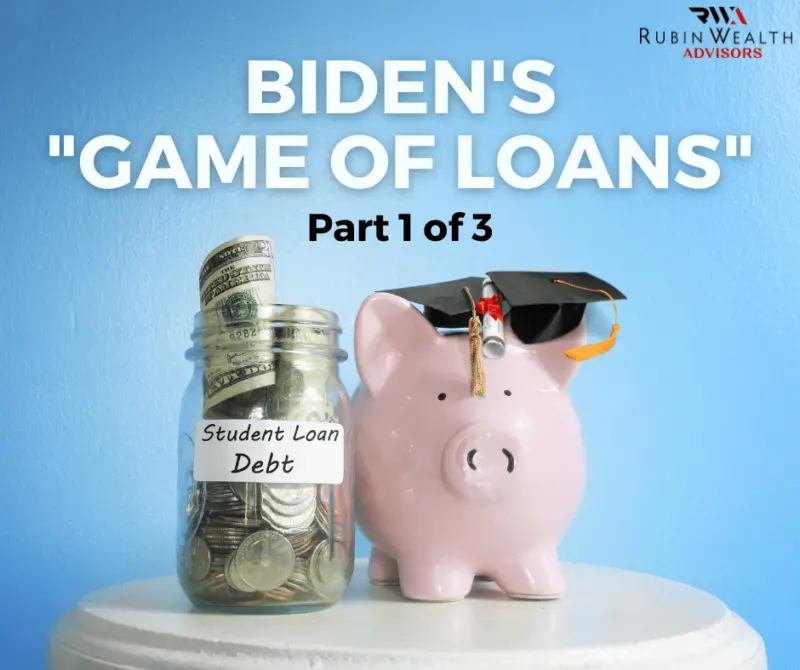
Welcome to part 1 of a 3-part series that discusses everything you need to know regarding Biden Debt Cancellation.

Perhaps the largest act of bribery committed in Western civilization is that committed by Joe Biden with a stroke of the pen. At a cost estimated by the smart folks at Wharton to run anywhere between $469 billion and $519 billion, his cancellation of student loan debt is clearly designed to make those who had their debt forgiven vote for Democrats out of gratitude and those who are contemplating future student debt vote for Democrats out of hope.

The Marshall Plan is designed to bring Europe together after WWII, achieving a sound objective at a paltry $150 billion in today’s dollars. What is the objective of Biden’s bailout of students? Votes. What will the results likely be? Even higher tuition costs. Nothing noble, just hubris and carnage.

Today Student Loan Landscape

Forbes ran a story in September that was well-researched and drew from multiple sources to provide an overview of the current lay of the student loan landscape.   Here are a few tidbits to hold onto from that article:

  • $1.75 trillion in total student loan debt (including federal and private loans)
  • $28,950 owed per borrower on average
  • About 92% of all student debt are federal student loans; the remaining amount is private student loans
  • 55% of students from public four-year institutions had student loans
  • 57% of students from private nonprofit four-year institutions took on education debt
  • In constant dollars, tuition costs at both private and public four-year universities have doubled over the past 30 years

As Milton Freidman said, inflation is always a monetary phenomenon. Easy access to student loans has caused college costs to skyrocket. With so much liquidity available, universities can hike their prices with virtually no limits. The government would lend more money to students regardless of how high they raise their rates.

Universities raise tuition, the government lends more money, universities raise tuition again, the government lends more money, and so on. This perverse cycle is what TPUSA founder Charlie Kirk labeled nearly a decade ago as the “Game of Loans.”

Who Holds All the Student Loan Debt?

This may catch you by surprise but the federal government holds nearly all the student loan debt in the country. The government takeover of the student loan market is complete as part of the Affordable Care Act (I know, right?). This is what has enabled Biden to so easily forgive student loan debt; The federal government is the actual lender. Typically debt forgiveness is taxable to income to the borrower but that is not the case here.

Pause to consider this:  Your new IRS agent who shows up to audit you in 2023 is going to have had their debt freshly forgiven without any tax consequence. They are then going to tear your world apart, looking for any amount of money they can wring from your hide, including any advances that a friend or relative might have loaned to you, and then out of kindness, said you didn’t have to pay back! Make you mad? It should!

The federal government is printing money to put you or your children into debt and now has added the twist of making your bet that after this round of debt forgiveness, they will do it again in the future.

This is the inflationary aspect of the new debt forgiveness program. By signing this legislation, Biden already injected these dollars into the economy. They have already had an inflationary impact on university prices, which has rippled to overall price levels. Students feel like they are “starting over” and will be inclined to borrow more money in the future with the hopes that students will disregard it.

This will lead to the federal government printing more money, the universities raising their tuition, the federal government printing more money…

Check out part 2 of the Game of loans series to learn more about Biden Debt Cancellation.

bob rubin

Are you concerned about inflation, ESG compliances, and the 2022 crypto crash?

Your investment portfolio can be affected by any or all of these factors.

Schedule an appointment with Bob Rubin, your dedicated, conservative financial advisor, for a free portfolio analysis today.

Get started by clicking the button below.

No BS… Just straight forward advice

Contact Bob, the Nation’s Predominant
Politically Conservative Financial Advisor Today!

Call Bob @ (561) 288-1111

Email Bob @ Bob@RubinWA.com

Or schedule a call below!

Is Your Company 401k

401k at risk of litigation?

401k At Risk Of Litigation?

Is Your Company 401k

In 2020, there were over 200 lawsuits alleging malfeasance and negligence, among other things, against 401k plan sponsors. Earlier in 2021, life insurance firm John Hancock settled a 401k lawsuit for $14 million. The lawsuit accused John Hancock of alleged self-dealing and listing their own series of products in the investment lineup for the plan, even though there were lower-cost alternatives with better-proven track records. They were also accused of having excessive administrative fees when compared to similar-sized plans. Along with the $14 million settlement, John Hancock agreed to retain a 3rd party investment consultant for the next 5 years, develop an investment policy statement, and help negotiate record-keeping costs. If a large company like John Hancock can get hit, then that begs the question – Is YOUR 401k a litigation risk?

Due to the COVID-19 pandemic and the increased amount of time people have spent at home, more and more employees have begun to look into their 401ks. And from the looks of it, things must not have been so great, because there’s been an 80% increase since 2019 from the amount of 401k class actions that have been filed, with that number being more than double what it was in 2018.

Rubin Review

Usually, these lawsuits tend to target the larger plans because of the financial incentive, but that has started to change over the recent years. As everything adopts a more digital approach, it has become much easier to find information on plans of all sizes, including the smaller ones. Smaller 401k plans don’t always have the professionals on board to make sure all the moving parts of the plan are working in conjunction with one another, making them an easy target for predatory law firms that need only just a few disgruntled former employees to move forward with their litigation.

The fact of the matter is, most business owners and executives are focused on running the business, not the 401k. And why should they? You just put money in and forget about it, right? WRONG! There are a lot of details that need to be addressed in a 401k, such as-

  • Are there share classes with lower expense ratios?
  • Did you hire your recordkeeper without competing bids?
  • Are all contributions being submitted in a timely manner?
  • Are you identifying and enrolling eligible employees on time?
  • Are you sending the required plan notices to all eligible participants of the plan when required?

With that being said, maintaining a 401k is a lot of work. However, just because you have a lot going on doesn’t mean the 401k needs any less attention. If anything, it’s the exact opposite! As your business continues to grow and your team expands, you will have more participants in the plan and more to keep track of. Partnering with the right financial advisor who can help you navigate the complexities of company retirement plans is one of the first steps you can take in assuring you are taking proactive measures.

bob rubin

Are you concerned about inflation, ESG compliances, and the 2022 crypto crash?

Your investment portfolio can be affected by any or all of these factors.

Schedule an appointment with Bob Rubin, your dedicated, conservative financial advisor, for a free portfolio analysis today.

Get started by clicking the button below.

No BS… Just straight forward advice

Contact Bob, the Nation’s Predominant
Politically Conservative Financial Advisor Today!

Call Bob @ (561) 288-1111

Email Bob @ Bob@RubinWA.com

Or schedule a call below!

Politically

Put Your Money Where Your Values Are

Politically Conservative Investing : Put Your Money Where Your Values Are

Do your investments align with your values

Here is a politically conservative investing nightmare scenario – a moral dilemma that causes conflict to your very core. The perfect investment opportunity is presented to you. You are promised stable returns for years to come. The books check out, the company is legit and their finances are in good order. What’s the catch? What’s the hold-up from jumping while the iron is hot?  Here is the catch – this company uses its profits to advance an ideology you don’t believe in. The very profits you are helping to create are in turn used by this company to fund, support, and proliferate a liberal agenda that advocates for a bigger, more activist, and socialized government.

Why I Try To Invest In Companies That Share My Conservative Principles.


On the one hand, you can reap the financial benefit of investing in this company. On the other, you are faced with a gnawing feeling that your money is being used to support the very policies you oppose. What is the point of great financial returns only to find out that your money is going to be taxed away by politicians elected by the very profits you helped create with your investment? A real soul twister.


I have been there, and I hated the feeling. Knowing that my money, my investment, my financial belief in a company was then used to fund liberal and progressive causes across the country was an issue I could not come to support. BLM protests, democratic candidates up and down the ticket, and ANTIFA groups all could be tied back to liberal dollars. I took a stand as I didn’t want my investment in company X to be part of that.


That’s why today I try to invest in companies that share my principles and my values.

Rubin Review

Now, this doesn’t mean investing in any old company. No. It has to financially make sense for your investment goals, both short and long term. Nevertheless, the benefits of “Principled Investing” are worth the extra work in researching in how companies utilize their profits.


The benefits of putting your money where your values are:

  • A portfolio that meets your financial goals;
  • Gives your investments a secondary sense of purpose;
  • Investing becomes more than just making money;
  • Your money only goes to support causes and issues you care about;
  • Peace of mind knowing your investments are making a difference;
  • A portfolio that shares your values.
 

This bigger challenge today is not just determining whether to invest in Company A or Company B, but also ensuring the various index funds, mutual funds, and ETFs you put money into are also only investing in companies that match your values.  It is not possible to only invest in politically conservative companies but to the extent that you can, you should.  This can be even more time-intensive as you scour the books to see which company does what and how they use their profits. For me, that research is worth the peace of mind I get knowing my investments are making money and not aligning with policies I see as detrimental to my family or my business.


Today, there are options for conservative traders who want their money to go with their values. Everything from firms that will do the research for you, to wealth advisors who do hard work to try to make sure you are making the right investment – financially and morally.


Whichever the case may be for you, the choice is very clear. When returns are not enough and you want to ensure your investments mirror your values, it’s time to invest in companies that share your morals and principles.


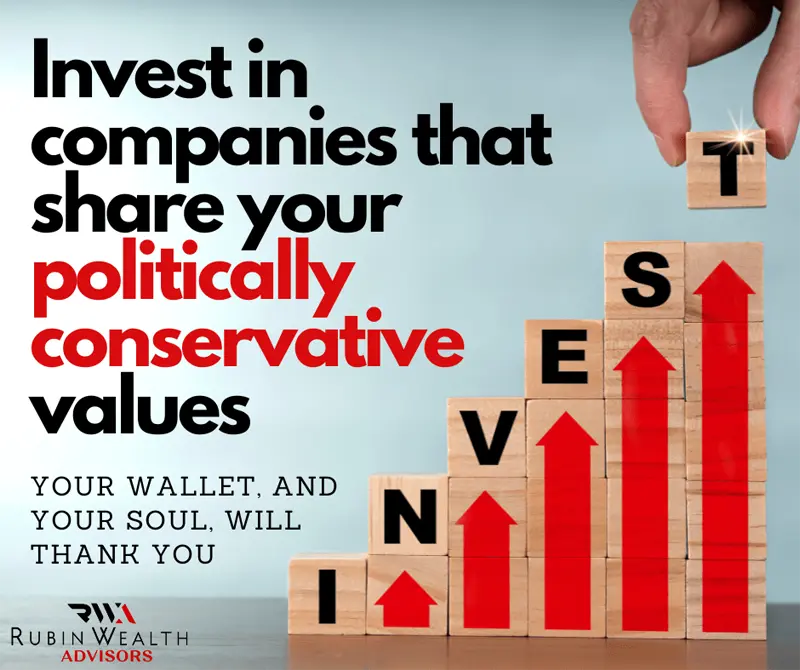
Put your money where your values are. You, your wallet, and your soul will thank you.

Need help? Contact me today so we can get started!

bob rubin

Are you concerned about inflation, ESG compliances, and the 2022 crypto crash?

Your investment portfolio can be affected by any or all of these factors.

Schedule an appointment with Bob Rubin, your dedicated, conservative financial advisor, for a free portfolio analysis today.

Get started by clicking the button below.

No BS… Just straight forward advice

Contact Bob, the Nation’s Predominant
Politically Conservative Financial Advisor Today!

Call Bob @ (561) 288-1111

Email Bob @ Bob@RubinWA.com

Or schedule a call below!

ESG Funds

Environmental, Social, and Governance Funds – A False Promise

Environmental, Social, and Governance Funds – A False Promise

ESG Funds

Since the moment that man left the state of nature and consented to be governed, the government has been in the business of helping to choose who the winners and losers are in business.  During the rule of despots and tyrants, this was done in a not-too-subtle way.  The emergence over centuries of various forms of democracy and free-market economies in the West has forced government leaders to get more refined in how they favor sectors or companies.

In today’s America, government choosing winners and losers is most often choreographed through the use of the Internal Revenue Code or through the issuance of, and exemptions from, regulations.  This is exactly what is now taking place with environmental, social, and governance (ESG) investment funds and while the companies in those funds will be coming out winners, individual American investors will be the losers if they are not paying attention.

ESG funds are the politically correct bundling of publicly traded companies that conform to today’s socialist agenda.  These are companies that “aren’t” certain things (weapon manufacturers, tobacco companies, fossil fuel producers, etc.), companies that help support, fund, and promote socialist causes (Amazon, Comcast, Meta, Twitter, Google, etc.), and finally, companies that are actively engaged in advancing socialist causes through the sale and distribution of their own goods and services, such as any type of “green energy” company.

Under the Trump administration, rules were issued that governed financial advisors and the requirements for how they recommend funds to investors.  The rule emphasized the need to focus on “pecuniary factors” which in simple language means the dollars and cents of the fund’s cost and potential return.  Now, under new rules being proposed by the Biden administration, not only will financial advisors be freed from that constraint where ESG funds are concerned, but investors may actually be unwittingly placed into those funds without their express approval.

Under the proposed rules that are being promulgated by the Department of Labor (the Department that regulates 401(k) investment activity), financial managers of company 401k plans will be able to set an ESG fund as the “default investment” should an employee not deliberately select a particular fund into which their retirement dollars are to be placed.  Traditionally, those default investments have been made into funds designed to produce maximum asset growth over the employees’ estimated remaining working years to retirement.  Now, your financial future and security can be made subordinate to serving the “greater good.” Think – Atlas Shrugged.

Financial planners will now be able to push these ESG funds to investors without the need to focus on comparative costs and returns.  This means that an individual can be effectively steered into a fund under the naïve belief they are somehow stopping climate change when in reality they are limiting the financial return they receive on that investment.

I am not at all against the establishment of ESG’s or allowing individuals to be able to invest in those kinds of funds.  What should be of great concern to every American is the Biden administration wants to get involved in essentially tricking Americans into investing in these funds either unwittingly or without the full information needed to make a sound choice.

I believe that the right way for someone to help to contribute to any cause in which they believe, social justice or otherwise, is to invest their time, talent, and treasure into activities that provide the greatest financial return.  They can then use these returns as the means by which to promote their favorite initiative.  They can solar panel their home, buy a windmill for the local church, fund a study to combat cow flatulence, or whatever it is they want to do to help save the planet or save anything for that matter.

What they should not do is be tricked by the government into investing in a fund that will cost more, return less, and have a negative impact on their own financial security.

Some financial advisors will point to the inclusion of companies in ESG funds like Amazon, Comcast, and Twitter as a way to suggest that strong performers are in these socialist-engineered investment vehicles.  That claim is technically true and functionally irrelevant.  Those referenced companies are in many other funds that include companies that are chosen for their financial contribution to the fund’s performance, not for their contribution to causes supported by the likes of AOC and Bernie Sanders.

We all remember Solyndra, the bankrupt green energy company supported by the Obama administration to the tune of over $500 million lost taxpayer dollars.  Whether you believe in solar power or not, these companies need to succeed or fail on their own without the intervention of the government.  Sad but true, the government is much better at picking losers in the market than it is in picking winners.

The recently exposed scandal at Deutsche Bank highlights the problems that take place when investment firms start to mix political considerations with those of simple return on investment criteria.  The German-based bank had been aggressively promoting its ESG investment commitments to its woke client base only to discover that some mid-level fund managers were not toeing the line in terms of directing client money into ESG funds.  Those managers were concerned about the actual financial returns in those funds when compared to other traditional alternatives.  Deutsche Bank now finds itself under investigation by both government and media for its puffed-up claims about ESG commitment.

They might have been better off just focusing on making sound investment decisions.

As individual citizens, there is little you can do to stop the proposed new regulations on this ESG… What you can do is make sure that you pay attention to your 401k investment selection and that you work with a personal financial advisor that will remain committed to you and your family’s financial well-being.

bob rubin

Are you concerned about inflation, ESG compliances, and the 2022 crypto crash?

Your investment portfolio can be affected by any or all of these factors.

Schedule an appointment with Bob Rubin, your dedicated, conservative financial advisor, for a free portfolio analysis today.

Get started by clicking the button below.

No BS… Just straight forward advice

Contact Bob, the Nation’s Predominant
Politically Conservative Financial Advisor Today!

Call Bob @ (561) 288-1111

Email Bob @ Bob@RubinWA.com

Or schedule a call below!

Is Inflation turning us into the next Venezuela?

Is Inflation turning us into the next Venezuela?

Is Inflation turning us into the next Venezuela?

Is Inflation turning us into the next Venezuela?

A week ago, I was in a local sandwich shop and check cashing store (a traditional goods & service combination) owned by a friend, a hardworking entrepreneur.  He seemed very stressed out and I asked him why.  He said that he had just had to raise the price of his sandwiches from approximately $9 to just over $12 and he still wasn’t sure if he was making any money this week.   I asked, “this week?”  He replied yes and then explained.

He said that in the past week the price of turkey had doubled.  The prices of other sandwich fixings had gone up by anywhere from 20-50 percent over the same time frame.  What’s more, he said that he could not count on supply because it was getting so hard to get fresh produce.  Day to day, he didn’t know what he would have on hand.  Selling 300 sandwiches a day, this entrepreneur doesn’t know if he is losing money on every order and trying to make it up on volume.


Continuing my journey, I then went to the pool supply store where I talked to my pal Joe whom I have known for years.  Joe offers up on his own that the price of chlorine has increased 25 cents in its normal unit of measure.  He said that he has been buying chlorine from the same company for years and the typical price movement is about a penny per year in that same unit of measure.


Have I suddenly found myself in Venezuela?

Everywhere I go I hear the same message from merchants.  These two representative anecdotal stories of mine can be multiplied by tens of millions from other Americans of all socio-economic strata across the country, each of whom is experiencing the early, but rapidly progressing stages of inflation.

The government has been lying to you about this.  They are lying to you about the level of inflation, and they are lying to you about what is causing it. It all comes down to basic economics.

The Nobel Prize-winning economist Milton Friedman was famous for saying, “Inflation is always and everywhere a monetary phenomenon in the sense that it is and can be produced only by a more rapid increase in the quantity of money than in output.”  To translate, he’s saying, printing too much money leads to inflation.

Friedman’s statement should almost be considered axiomatic rather than a theory in that the only way that prices can rise across the board in a country is if there is too much money chasing too few goods.  As the champion of monetarist theory, Friedman would point to the simple equation:

                          MV=PQ

In that formulation, M is the amount of money in circulationV is the velocity at which that money is exchangedP is the general price level, and Q is the quantity of goods and services.  As even a “C” level math student knows, if the M in that equation goes up, then something has to increase on the other side of that equation in order to maintain balance.

Well, the “M” in Friedman’s famous equation has been going up for quite some time.  In 2020 we saw a historically high growth in our money supply in what is referred to as M2 (includes cash and checking deposits, savings deposits, money market securities, mutual funds, and other time deposits) of over 27%.  With our GDP growth nearly flatlined (the “Q” in the equation, you might wonder why prices (the “P”) haven’t skyrocketed prior to now?  Could Freidman and his equation have been wrong?

The answer is that the velocity of money being spent has also slowed in recent times.  This has partially offset the increase in the money supply.  That is until now.

Under the Biden administration, supply chain issues largely contributed to by poor centralized management of the economy have created shortages which have drastically reduced the “Q.”  With the “M” already at historically high levels, that means that there has been upward pressure placed on, you’ve got this, the “P” price level.  That’s why my sandwich cost so much and why some people’s pool water might have to go “au naturel” for the immediate future.

There is no end in sight to this not-so-hidden tax on every American’s wealth.  What are you supposed to do to try to protect yourselves from the ravages of inflation?  You need to realign your portfolio to recognize the fact that inflation is here, it is here to stay, and it is going to get worse.  Here are a few considerations that should be considered by everyone ranging from the most affluent to the hourly wage worker with a 401K:

  • Reduce your investments in bond obligations: Since rising inflation leads to higher interest rates, that means the underlying value of most bonds will decrease because the majority of them are issued with fixed rates of interest.  If interest rates rise, and the coupon rate on your bond is low, then the market offsets that discrepancy by lowering the price at which the bond trades.  In simple terms, that means the bond you hold today that you might be able to sell for 99 cents of its redeemable value might sell for 80 cents of that same value next week.
  • The above rule especially applies to lower-rated bonds: Most people are at least somewhat familiar with the concept of bond ratings.  There are groups out there that give quality ratings to bond issuance based upon the creditworthiness of the issuer.  Generally speaking, the lower the bond’s rating the higher the nominal, or coupon, rate of interest to help offset the risk.  Many people have moved into riskier rated bonds over the past few years to try to get a higher interest rate.  These bonds will be more severely impacted in their price during an inflationary environment.
  • Consider crypto assets: Crypto assets are quite possibly the new “gold” in terms of hedging against inflation.  Historically, people have turned to gold and other precious metals as investments during times of rapid inflation because since they are a “fixed” asset in terms of actual availability they do not run the risk of being mass produced like a paper, or book-entry, currency.  In the 21st Century, crypto assets like Bitcoin have some of the same supply-limiting features of gold and precious metals so their relative scarcity and existence outside of the current money supply can makes them a possible inflation hedge.
  • Other “hard asset” investment should become an easier choice: Think real estate and other things that are tangible.  While changes in the structure of commercial real estate use are numerous at this time owing to permanent increase in working from home vs. office and the shift from in-person retail shopping to e-commerce, real estate that has its highest and best use being exploited remains a good inflation hedge.  The government cannot masse-print dirt.  Real estate is limited and will always be needed.  Likewise, other physical items can be a good inflation hedge.  Quality art has always been a favorite as an inflation hedge.  If you were thinking of buying that Rembrandt, now might be the time.

    The old days of a 60-40 or 70-30 rule of your portfolio being divided between securities and bonds has officially passed.  Strategies are now needed that take inflation as a given and not as a potential.  To navigate the treacherous field of how to both protect and grow your portfolio you need to make sure that you are working with a professional who does not dismiss inflation as a passing trouble that will be gone in an 18-month cycle.  It is the value of your portfolio that could be gone in 18 months.  Choose an advisor who understands that reality.

    Now back to my $12, oh wait…, I mean $15 dollar sandwich.

bob rubin

Are you concerned about inflation, ESG compliances, and the 2022 crypto crash?

Your investment portfolio can be affected by any or all of these factors.

Schedule an appointment with Bob Rubin, your dedicated, conservative financial advisor, for a free portfolio analysis today.

Get started by clicking the button below.

No BS… Just straight forward advice

Contact Bob, the Nation’s Predominant
Politically Conservative Financial Advisor Today!

Call Bob @ (561) 288-1111

Email Bob @ Bob@RubinWA.com

Or schedule a call below!